Citizen innovation: digital and collaborative participatory tools
How can municipalities move from top-down decisions to co-planning with citizens? INCIT looks at what makes digital participation work in French-speaking Swiss municipalities.
Best Research Poster · Open Living Lab Days 2026
“Digital participatory tools for urban experimentation and co-design: experiences from cities and Living Labs in Switzerland”
Yaël Bitter, Anastasia Ponomareva, Fiona Zimmermann
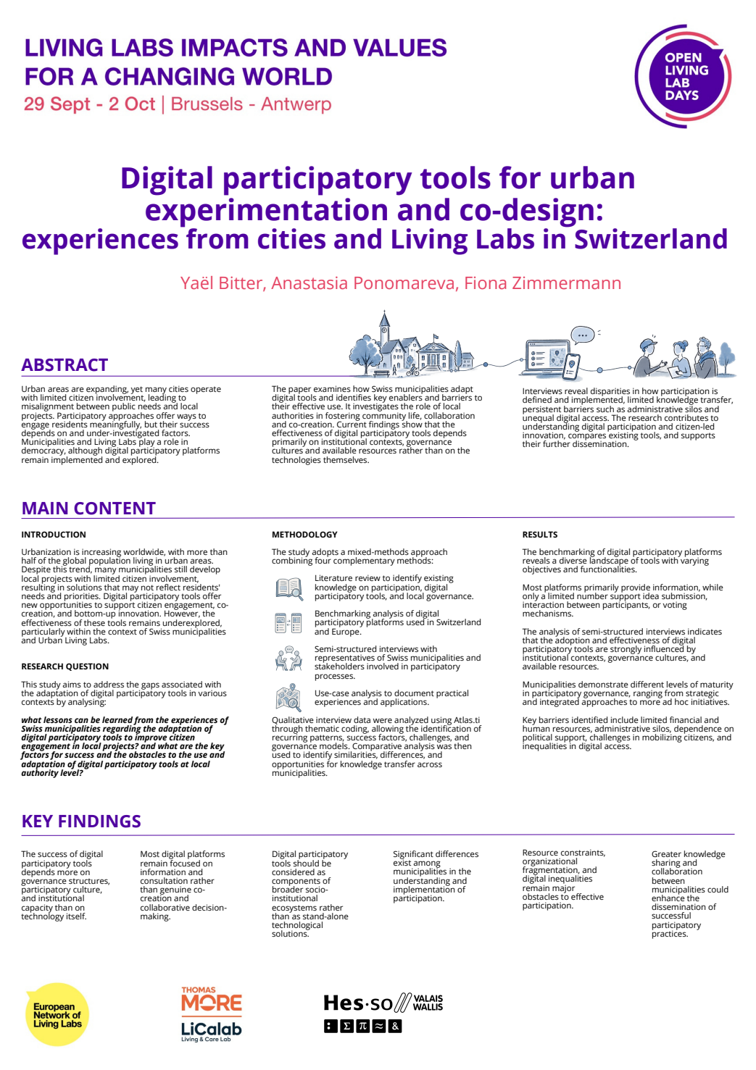
Open Living Lab Days 2026 · 29 September – 2 October · Brussels – Antwerp
Context
More than half of the world’s population now lives in urban areas. Yet many cities and municipalities still design projects and public policies without consulting the people concerned, which limits both public support and relevance.
Digital participatory tools can help, from simply sharing information to deliberation, co-creation and following up on public decisions. But many local authorities still use them one way, to inform rather than to interact.
Their success depends less on the technology than on goals, resources, institutional context and local participatory culture. This is what led the Energy Living Lab at HES-SO Valais-Wallis to study the conditions that help municipalities adopt and use digital participatory tools.
Research questions
What are the main levers and obstacles for citizen participation, and then for e-participation, in French-speaking Swiss municipalities?
What lessons can be learned from their experience with digital participatory tools to strengthen citizen engagement in local projects?
Methodology
Participation, digital participatory tools and local governance.
The main digital participatory tools used in Switzerland, with European examples.
With municipalities and organisations involved in participatory processes.
A practical example of participation and digital tools within the City of Lausanne.
Key findings
The success of digital participatory tools depends more on governance, participatory culture and institutional capacity than on the technology itself.
Most platforms remain focused on information and consultation rather than genuine co-creation and collaborative decision-making.
Digital tools should be seen as part of a broader socio-institutional ecosystem, not as stand-alone technical solutions.
Municipalities differ widely in how they understand and implement participation.
Limited resources, administrative silos and digital inequalities remain major obstacles.
More knowledge sharing and collaboration between municipalities would help successful practices spread.
Output
INCIT developed and co-built a toolbox that helps municipalities, associations and institutions introduce participation and e-participation through an interactive presentation.
It comes with technical sheets to support project managers as they design and run participatory processes.
Citizen innovation
Let’s talk about participation, digital tools and the INCIT toolbox.

This site uses cookies to offer you a
better browsing experience.